
From the Gulf to the Caucasus: The Security Risks of a Wider Iran War
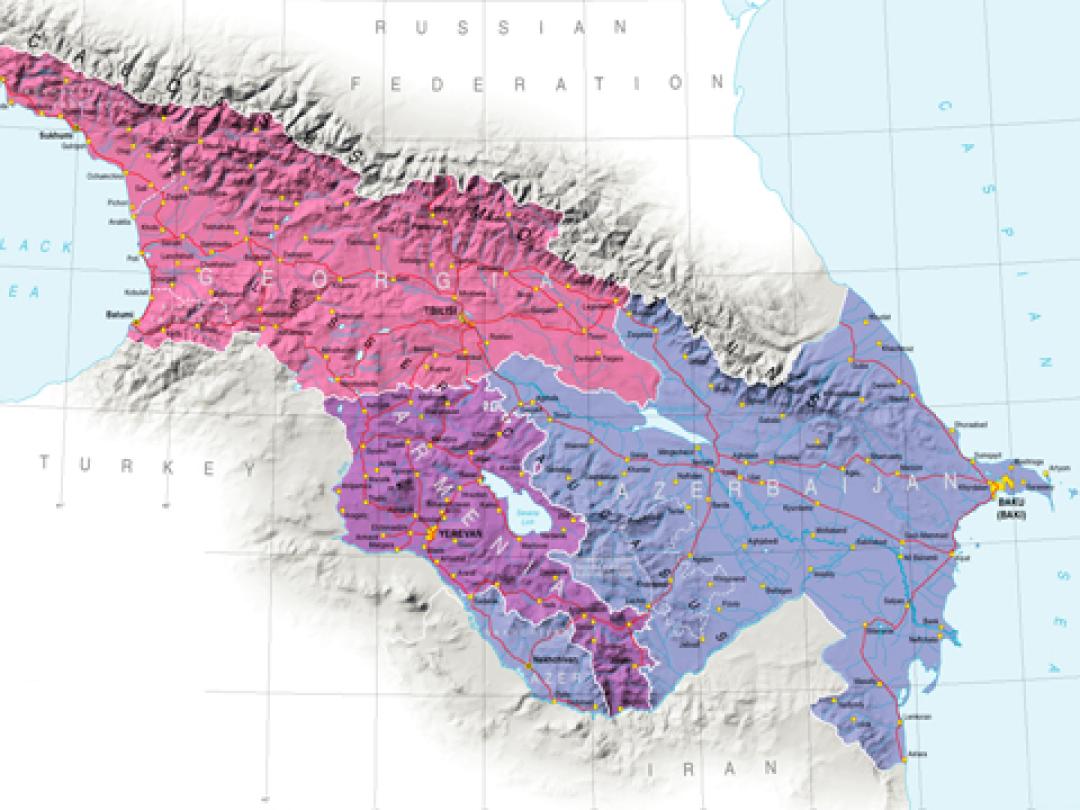
The intensifying confrontation between Iran, the United States, and Israel is not merely a Middle Eastern crisis—it is a geopolitical shockwave whose effects extend far beyond the Gulf. Among the regions most vulnerable to its consequences is the South Caucasus, a strategically located but politically fragile space where unresolved conflicts, competing alliances, and critical energy corridors intersect. As the war escalates and global powers deepen their involvement, the security environment of Armenia, Azerbaijan, and Georgia may face unprecedented pressure.
The South Caucasus sits at the crossroads of several geopolitical fault lines. It borders Iran directly, hosts key energy and transport routes connecting the Caspian Basin to Europe, and remains shaped by the unresolved aftermath of regional conflicts. In this context, a prolonged Iran–U.S.–Israel confrontation could transform distant military operations into immediate security concerns.
Beyond the danger of physical spillover, the war has the potential to reshape the strategic balance among regional actors. The region’s critical infrastructure also represents a major vulnerability. Pipelines such as the Baku–Tbilisi–Ceyhan corridor and other energy routes linking the Caspian to European markets are strategic assets in the global energy system. Any credible threat to these corridors—whether through sabotage, cyber operations, or military escalation—would not only destabilize the South Caucasus but also disrupt energy security for Europe. In a period of global uncertainty, such disruptions could amplify geopolitical tensions and economic volatility across a much wider area.
Furthermore, the South Caucasus remains characterized by what analysts describe as an “armed peace,” where unresolved disputes and fragile diplomatic arrangements continue to shape regional stability. In this environment, external crises can act as catalysts for local escalation. A major war involving Iran could create strategic distractions for international actors, shift power balances, and open opportunities for regional players to pursue unresolved territorial or political objectives.
Iran’s Strategic Concerns: Regional Escalation, Foreign Interference, and TRIPP
In an interview with Caucasus Watch, Iranologist Pooya Hosseini, head of the “Armenia-Iran Strategic Cooperation Development Center” Foundation, warned that the greatest danger of the war lies in the risk of its expansion. “Before the war, Iran had warned that this war would become regional, and we are already seeing that nearly ten countries are directly or indirectly involved in it. In the region, all countries that have provided military bases to the United States are considered legitimate targets for Iran. If the war expands and gets out of control, Israel may want to open another front against Iran, including from the South Caucasus. For years, Israel has sold large quantities of weapons to Azerbaijan, and this was done precisely for days like these. The accumulation of such a large amount of weaponry in Azerbaijan was not aimed at Armenia, but rather at Iran. They may also try to demonstrate activity through Azerbaijan and open a new front against Iran. However, Iran has strongly warned Azerbaijan not to become a pawn in the hands of that regime, and if Iran sees Israeli activity in Azerbaijan, it will target it as well. It is known that Israel has intelligence posts and military targets there, and Iran also targets economic interests. The largest economic interests are the Baku–Tbilisi–Ceyhan pipeline, which transports large volumes of oil to Israel. The pipeline could also come under Iran’s targeting if Israel tries to use Azerbaijani territory against Iran. In that case, instability would spread throughout the South Caucasus region, and the repercussions of the war would reach the South Caucasus as well”, the Iranologist affirms.
In response to our question—whether the reported appearance of Iranian drones in Nakhichevan could alter the military-political balance in the region—Mr. Hosseini reminds us that Iran has officially stated that those drones were not from Iran and has not ruled out the possibility that Israel carried it out, aiming to provoke Azerbaijan into responding to Iran and to move the conflict into the Iranian–Azerbaijani arena.
“If Iran is targeting, it generally announces it directly, as it does in the case of Arab states: it openly says whose side it was on and has no reservations about it. And this precisely proves that Iran did not use it. Azerbaijan tried to take advantage of the occasion to gain political dividends from the West, presenting itself as the aggrieved party in the war, while also signaling that it could lash out at Iran and that it is part of this anti-Iranian conflict—thereby hoping to secure political gains from the United States and the West,” Hosseini asserts.
Could this war also affect TRIPP’s plans, altering or derailing its intended course? In this regard, the expert believes that, overall, it will not, because Iran and Armenia maintain good relations and have mutual understanding.
“For months, Armenia had tried to convince Iran that TRIPP could not become a project against Iran’s interests. However, no matter how much Iran trusts Armenia, the problem is that the agreement is trilateral, and Iran does not trust the other parties—Azerbaijan and the United States. Before the war, Iran took a very mild stance on the TRIPP issue. But now, under the conditions of war, with the Iran–U.S. conflict deepening and mutual hostility prevailing, Iran’s position on TRIPP could become tougher. Nevertheless, efforts should still be made to ensure mutual understanding between the two sides on this matter. There are two approaches in Iran: it can trust Armenia, but history has shown that a deep atmosphere of distrust exists between Iran and the United States. “Iran maintains that in every region where the United States has entered with economic and humanitarian programs, those initiatives have eventually turned into security and military presence. In other words, they first establish a humanitarian presence, consolidate their foothold in the region, and then transition into a military and security role. This is what worries Iran,” summarizes Iran’s position Iranologist Pooya Hosseini.
From Nakhichevan to Northwestern Iran: Rising Tensions Signal Shifts in Regional Influence
In a conversation with us for this article, Iranian studies expert and a former journalist at “Alik”, an Armenian-language newspaper in Tehran, Tigran Davudyan said he believes the Iran–U.S.–Israel confrontation could trigger a broader realignment of power across the region.
“A weakening of the Islamic Republic of Iran’s positions is evident, and if the Islamic system collapses, Israel will gain new weight in Iran. Given Israel’s presence in Azerbaijan, such a development could weaken Turkey’s position. Although Israel and Turkey are both Western allies, they are regional rivals, including in the Middle East. This rivalry is clearly visible in Gaza and Syria. Israel imports a large portion of its oil from Azerbaijan. By preserving that pipeline, Israel could, in the event of the Islamic Republic’s collapse, gain access to Iranian oil through a shorter route. Another potential risk for the South Caucasus could be the possible emergence of autonomous entities in Iran, something that has also been hinted at by Trump and is reportedly being pursued in practice by Netanyahu. This refers to Iran’s Kurdish- and Azeri-populated regions, which could seek autonomy if the central authorities in Tehran weaken. In that scenario, an autonomous actor could emerge in the South Caucasus that, backed by the Turkey–Azerbaijan tandem, might set its own terms for communication routes and trade connections. It should be noted that during the Second World War, we also witnessed autonomous movements in Iran’s Azerbaijan and Kurdistan regions.
Expert Davudyan explains the situation regarding the reportedly fired missile at Nakhichevan as a reflection of the current partial lawlessness in Iran.
We are also seeing signs of autonomous action among military figures. Recently, they ignored even President Pezeshkian, a member of the provisional leadership council. The military asserts that, following the directives of the fallen leader, they are ready to ‘fire at will’ and, beyond targeting Israel and the U.S., will also act against neighboring countries that host bases for this hostile duo—including Shia Azerbaijan. The missile launched at Nakhichevan should be viewed in this framework, as it clearly inflicted damage on the Islamic Republic of Iran and largely advanced the interests of the U.S., Israel, and Turkey.
Responding to our question — ‘If the conflict drags on, could it expand geographically and impact additional territories?’—Mr. Davudyan noted: “After the Nakhichevan incident, Iran’s armed forces warned Azerbaijan to remove Israeli bases from its territory. In the light of this threat, it is possible that we may witness a ‘new expansion of territories’ as well. The Nakhichevan incident, coupled with increased activity in Iran’s Kurdish regions, offers Turkey an opportunity to, as it did in Syria, portray its security as ‘threatened’ and to send troops into the Kurdish-populated areas of northwestern Iran. If that occurs, the strategic and political configuration of forces in the South Caucasus would be altered as well.”
On the future of TRIPP, Tigran Davudyan forecasts that the ongoing Iran–U.S.–Israel conflict will likely slow down the execution of TRIPP’s plans.
“The main player in TRIPP, the U.S., remains focused on the prospect of war against Iran. In the event of a possible regime change in Iran, TRIPP would also lose its significance with the arrival of pro-Western forces. The statement by Iran’s armed forces following the Nakhichevan incidents is also ambiguous and gives cause for reflection. If they are threatening Azerbaijan to remove Israel from its territory, how could they tolerate the entry of TRIPP?՞, Tigran Davudyan concludes.
Strategic Realignments and Economic Risks: What’s at Stake for the Caucasus
Assessing the further risks of the Iran–U.S.–Israel conflict for the region, our next interlocutor, Armenian political commentator Hakob Badalyan,warns that Caucasian countries could be directly pulled into the fighting under this logic.
“While not the immediate Caucasian countries, Turkey—with its substantial population and regional influence—constitutes another layer of risk. Another layer of risk, naturally, is the issue of refugees—if the situation in Iran develops to the point of triggering a large influx of displaced people. Currently, such a refugee flow is fortunately not occurring. However, in theoretical scenarios, it would still pose a security risk for the Caucasus region. And, naturally, there are economic risks as well—directly for Armenia since a portion of freight transport passes through Iran. This represents a tangible figure for the Armenian economy, even though it amounts to roughly a quarter of the total volume. From this standpoint, economic risks should likewise be viewed in the context of regional security”.
The political commentator interprets the Nakhichevan incident within the framework of a scenario that might broaden the conflict’s geography or draw in additional actors, including Azerbaijan and Turkey. “We saw that the developments were not limited to Nakhichevan but also included the case of the two ballistic missiles connected to Turkey. Notably, Iran proposed that Turkey and Azerbaijan carry out an investigation to show that it was not responsible for the incidents, which I am inclined to interpret as an attempt to involve them further. It is also evident that both Turkey and Azerbaijan, understanding the serious risks of being drawn in, are trying to resist this attempt. How long they can resist and how Iran will engage with them is another question. However, I am convinced that forces interested in a war against Iran have an interest in viewing the Caucasus—particularly the northern and northwestern directions—as a potential new front, and that this scenario and attempt do exist. It is evident that Russia also has a stake in these developments. Recently, the Russian president spoke with Ilham Aliyev by phone, and I believe this matter was among the central topics of their conversation”.
The political analyst is confident that this war will alter not only the plans related to TRIPP, but more broadly, will reshape the regional picture both in the Caucasus and in the wider Middle East. “There is no doubt that these major changes will inevitably affect the fate of TRIPP as well. How exactly this will unfold naturally depends on a number of factors, primarily on how the war develops—both in its military sense and across the political and diplomatic dimensions. There is no question that the impact will be significant, with these changes affecting the region and having concrete consequences for geopolitically important projects, including TRIPP. The question is only in which direction and according to what logic this will occur”, Hakob Badalyan concludes.
Key Takeaways
Ultimately, the Iran–U.S.–Israel confrontation represents more than a distant geopolitical drama for the South Caucasus. It is a potential multiplier of existing security risks in a region already marked by fragile peace, competing alliances, and strategic transit routes. Understanding how this conflict could reshape the regional security architecture is therefore essential—not only for policymakers and analysts, but also for societies whose stability may depend on how the crisis unfolds.
The direct confrontation between Iran, the United States, and Israel serves as a stark reminder that the South Caucasus does not exist in strategic isolation. Even when conflicts erupt beyond its immediate borders, the region’s geography, political alignments, and economic infrastructure inevitably draw it into the wider dynamics of regional power competition. In such circumstances, risks rarely appear in a single form. They may emerge as military spillover, diplomatic pressure, economic disruption, or heightened tensions among neighboring states whose interests intersect with the broader confrontation.
For the countries of the South Caucasus, the challenge lies not only in responding to potential crises but also in preparing for them in advance. This requires careful diplomacy, balanced foreign policy choices, and strengthened mechanisms for regional stability. Maintaining open channels of communication with all relevant actors and avoiding steps that could unintentionally deepen regional polarization will be crucial for preventing external conflicts from translating into local instability.
Eventually, the trajectory of tensions between Iran, the United States, and Israel remains uncertain. Yet uncertainty itself has strategic consequences. In a region where security remains fragile and geopolitical competition is already intense, even the perception of escalating war can reshape political calculations and regional alliances. For the South Caucasus, vigilance, restraint, and proactive diplomacy may prove just as important as military preparedness in navigating the turbulent geopolitical environment ahead.
Contributed by Anna Vardanyan, an Armenian political journalist and researcher with over 18 years’ experience in defence policy, international relations, and security in Eastern Europe and the Caucasus, has worked for Armenian media and held advisory roles in the National Assembly of Armenia.