
Armenia and Azerbaijan Initial Peace Agreement in Washington
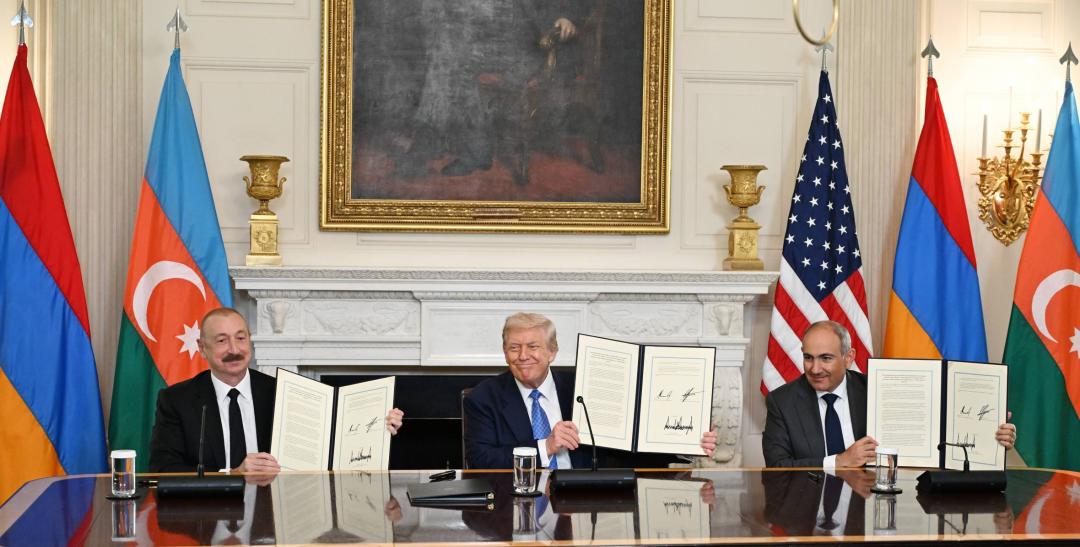
On August 8, US President Donald Trump hosted Armenian Prime Minister Nikol Pashinyan and Azerbaijani President Ilham Aliyev in Washington, where the leaders initialed a landmark Armenia-Azerbaijan peace agreement, announced the "Trump Route for International Peace and Prosperity," and received widespread international praise for their efforts to end decades of conflict in the South Caucasus.
Official Meetings
On August 8, US President Donald Trump held separate and joint meetings in Washington with Armenian Prime Minister Nikol Pashinyan and Azerbaijani President Ilham Aliyev to advance peace and strengthen strategic cooperation. During his meeting with Nikol Pashinyan, Donald Trump officially welcomed the Armenian leader in front of the White House. The two leaders exchanged a handshake and brief remarks before proceeding to bilateral discussions behind closed doors.
Similarly, President Trump welcomed President Aliyev in front of the White House, where they stood before the US and Azerbaijani flags, shook hands warmly, and had a cordial exchange before continuing their closed-door talks. In an informal meeting, President Trump also presented symbolic keys to the White House to President Aliyev. Additionally, a memorandum of understanding was signed between the United States and Azerbaijan to establish a Strategic Working Group to prepare a Strategic Partnership Charter. When asked by a journalist about the prospects for reconciliation, Trump stated, "I am very, very hopeful."
Later, Trump, Aliyev, and Pashinyan held a trilateral meeting and delivered joint statements. "I congratulate the President of Azerbaijan Ilham Aliyev and the Prime Minister of Armenia Nikol Pashinyan on their arrival in Washington to sign such an important document," Trump said. He announced that Washington was lifting restrictions on defense cooperation with Azerbaijan, calling it "a big deal." He also introduced the "Trump Route," which he said would "create new lines of communication that will break down barriers and open opportunities for investment, growth, and stability for many countries."
President Aliyev expressed gratitude to Trump for canceling the 907th amendment, stating, "This day will truly be imprinted in the memory of the Azerbaijani people." He emphasized that "Trump brought peace to the Caucasus" where previous mediators had failed, and credited the US President and his team for preventing an endless negotiation process. Aliyev described the new strategic partnership with the US as covering a wide range of areas, including mutual investments, trade, energy, and defense product sales.
Prime Minister Pashinyan stated that Armenia and Azerbaijan were entering a fundamental new stage in their relations by leaving the past behind. He stressed that this "would not have been possible without the personal involvement of President Trump." In closing, President Trump noted that while "minor problems" might arise, "the big, gigantic problems have been solved," and that both leaders could call him directly if needed.
Joint Statement
On August 8, President Aliyev and Prime Minister Pashinyan issued a joint declaration in Washington D.C. In the presence of President Trump, they witnessed the initialing of the agreed text of the "Agreement on Establishment of Peace and Interstate Relations between Azerbaijan and Armenia" by their respective Foreign Ministers. They also witnessed the signing of a joint appeal to the OSCE for the closure of the Minsk Process and its related structures.
The declaration reaffirmed the importance of opening communications for transportation based on respect for sovereignty, territorial integrity, and jurisdiction. This included ensuring unimpeded connectivity between mainland Azerbaijan and its Nakhchivan Autonomous Republic through Armenian territory, with reciprocal benefits for Armenia. Armenia committed to working with the US and other parties to establish a framework for the "Trump Route for International Peace and Prosperity" (TRIPP) project on its territory. The leaders rejected any attempt at revenge, affirmed the inadmissibility of using force for territorial acquisition, and expressed deep gratitude to President Trump for his significant contributions.
Aliyev's Conversations After Washington Deal
On August 9 and 10, President Aliyev held a series of phone calls with the leaders of Türkiye, Uzbekistan, Turkmenistan, Kazakhstan, and Pakistan.
With Turkish President Recep Tayyip Erdoğan, he discussed the significance of the signed documents and the start of Azerbaijan’s natural gas exports to Syria via Türkiye. Erdoğan congratulated Aliyev and reaffirmed Türkiye’s support for stability.
With Uzbek President Shavkat Mirziyoyev, he reviewed the Washington agreements and mutual investments, including Uzbek projects in Karabakh.
With Turkmenistan's Chairman of the Halk Maslahaty, Gurbanguly Berdimuhamedov, he highlighted the growth of friendly ties and the benefits of the new transport links.
With Kazakh President Kassym-Jomart Tokayev, he discussed the historic significance of the agreements for regional cooperation and the enhancement of the Middle Corridor's transit capacity.
With Pakistani Prime Minister Muhammad Shehbaz Sharif, he reviewed the outcomes of the Washington meeting and discussed expanding cooperation in economy, energy, and trade. In all conversations, Aliyev consistently stressed the important role US President Donald Trump played in the achievements.
Pashinyan and Mirzoyan's Conversations After Washington Deal
On August 11, Prime Minister Pashinyan held a phone conversation with Iranian President Masoud Pezeshkian, outlining the results of the negotiations and stressing that regional communications would function based on territorial integrity, sovereignty, jurisdiction, and reciprocity.
He also spoke with King Abdullah II of Jordan, who congratulated him on the establishment of peace.
In a call with Russian President Vladimir Putin, Pashinyan briefed him on the initialing of the peace agreement, the joint request to dissolve the OSCE Minsk Group, and the "Trump Route" project.
With French President Emmanuel Macron, Pashinyan presented the outcomes of the talks and emphasized that the peace agreement would open new investment opportunities.
Separately, Armenian Foreign Minister Ararat Mirzoyan and Indian Foreign Minister Subrahmanyam Jaishankar discussed the normalization of relations, with Jaishankar voicing support for the peace process.
Reactions
On August 8 and 9, numerous countries and international leaders welcomed the peace agreement.
Türkiye called it "a highly significant development for the promotion of regional peace and stability."
The European Union, through High Representative Kaja Kallas, described it as "a significant breakthrough to end decades of conflict."
Kazakhstan's President Kassym-Jomart Tokayev hailed it as a historically important achievement.
Pakistan's Prime Minister Shehbaz Sharif welcomed it as the beginning of a new era of peace.
Positive statements were also issued by Austria, the United Kingdom, Germany, Iran, Moldova, Georgia, Hungary, and Poland.
The French Foreign Ministry welcomed the agreements as "a decisive step forward" and supported the joint appeal to dissolve the OSCE Minsk Group structures.
News,
Politics,
Armenia, Azerbaijan |
Nikol Pashinyan, Ilham Aliyev, Donald Trump, Armenia-Azerbaijan Relations