
Azerbaijan, Turkmenistan, and Uzbekistan Strengthen Regional Cooperation Across Multiple Sectors in Turkmenbashi
Source: president.az
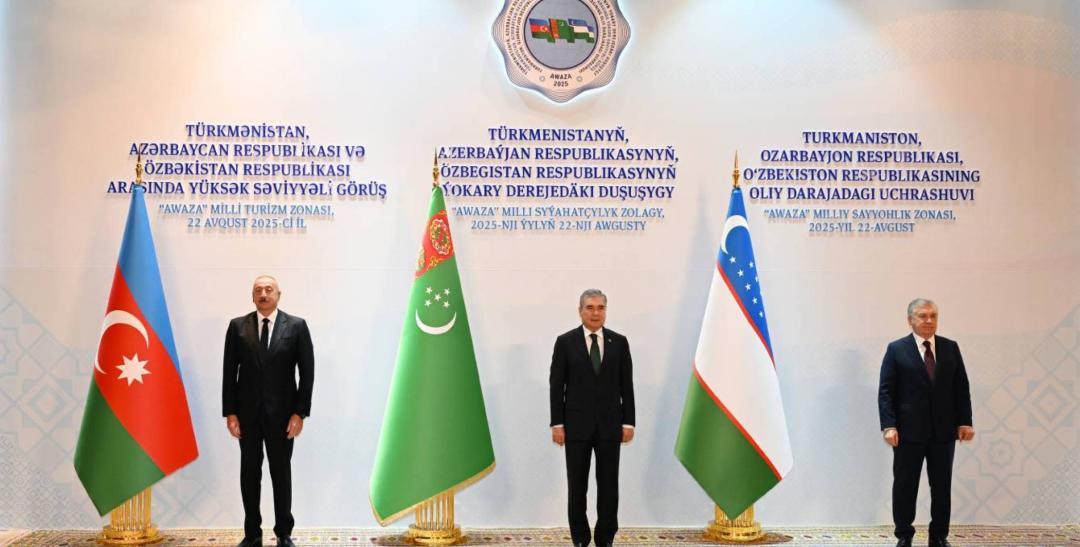
On August 22, Azerbaijani President Ilham Aliyev, Turkmen leader Gurbanguly Berdimuhamedov, and Uzbek President Shavkat Mirziyoyev held bilateral and trilateral meetings in Turkmenbashi. The meetings focused on energy, transport, trade, logistics, and regional cooperation, culminating in several signed agreements to expand infrastructure and industrial and transport linkages across the Caspian and Central Asian regions.
Meetings with Gurbanguly Berdimuhamedov
On August 22, Ilham Aliyev, President of the Republic of Azerbaijan, arrived in Turkmenistan for a working visit at the invitation of Gurbanguly Berdimuhamedov, Chairman of the Halk Maslakhaty of Turkmenistan. Aliyev held a one-on-one meeting with Berdimuhamedov, where the two leaders posed for photographs. An expanded meeting was also held in Turkmenbashi.
Aliyev emphasized the prospects for cooperation in energy, transport, logistics, transit, digitalization, and cultural relations. He noted that following Berdimuhamedov's July visit, the Intergovernmental Commission had already met and produced "excellent results." Referring to the East-West transport corridor that passes through both countries, Aliyev highlighted the importance of coordinated steps to maximize its potential as a reliable link between Europe and the Far East. He praised Turkmenistan's modern infrastructure—ports, airports, and railways—developed under Berdimuhamedov's leadership, noting that Azerbaijan had built similar facilities. Aliyev stressed that combining efforts in this field would benefit the wider region and that frequent bilateral meetings themselves carried important messages of unity and cooperation.
President Aliyev expressed gratitude for the greetings from President Serdar Berdimuhamedov and asked that his own greetings be conveyed in return. Both sides expressed satisfaction with the current level of political relations and underlined their mutual support within international organizations, with their positions aligning on global and regional issues. Aliyev cited Azerbaijan's role as a co-author of the UN General Assembly resolution on the "Permanent Neutrality of Turkmenistan" as an example of friendship and solidarity. He also congratulated Turkmenistan on successfully hosting the UN conference on Landlocked Developing Countries in August, noting Azerbaijan's high-level representation at the event.
For his part, Berdimuhamedov congratulated Aliyev on the normalization of relations between Armenia and Azerbaijan. Aliyev responded by stressing the importance of the new transport corridor connecting Azerbaijan's mainland with Nakhchivan through Armenia, noting that it would strengthen the East-West corridor, enhance regional transit potential, and benefit the entire region. The meeting also touched on the prospects of a broader transport corridor involving Azerbaijan, Turkmenistan, and Uzbekistan. Both leaders underscored the importance of the trilateral meeting held the same day, expressing confidence that it would provide further impetus to regional cooperation.
Trilateral Summit
On August 22, a high-level trilateral summit was held in Turkmenbashi with the participation of the President of Azerbaijan, Ilham Aliyev; the Chairman of the Halk Maslakhaty of Turkmenistan, Gurbanguly Berdimuhamedov; and the President of Uzbekistan, Shavkat Mirziyoyev. The leaders discussed strengthening cooperation in transport, trade, energy, and humanitarian fields, underscoring their countries' geostrategic role as a bridge between East and West, and North and South.
President Aliyev expressed gratitude to Gurbanguly Berdimuhamedov for organizing the summit, calling it the opening of a "new chapter" in trilateral cooperation. He praised Turkmenistan's socioeconomic achievements and highlighted recent developments in Azerbaijan-Turkmen ties, including the decision to construct a mosque in Fuzuli as a Turkmen gift and the establishment of sister-city relations between Fuzuli and Arkadag. Aliyev also commended Uzbekistan's support in restoring liberated territories, citing the construction of a school named after Mirzo Ulugbek in Fuzuli, a large sewing factory in Khankendi, and the "Uzbekistan" park in Baku. He emphasized that the three countries' joint work on the Middle Corridor, port and railway expansion, and energy cooperation would be of "great importance not only for our nations but for the wider region."
Berdimuhamedov described the summit as "historic," noting that Azerbaijan, Turkmenistan, and Uzbekistan are engaged in open dialogue across political, economic, cultural, and humanitarian spheres, while also cooperating within international organizations such as the UN. He highlighted progress in electric power cooperation, prospects in the gas sector, and the shared goal of restoring the Great Silk Road through transport corridor development in Central Asia and the Caspian Basin. He also emphasized expanding cooperation in education, science, healthcare, arts, and traditional crafts such as carpet weaving. In the energy sector, Berdimuhamedov announced the upcoming commissioning of a 1,574 MW power plant on the Turkmen coast of the Caspian Sea, which will enable electricity supply to Azerbaijan and transit to Europe via Azerbaijani territory. The declaration underscored the parties' shared goal of strengthening energy cooperation and expanding the export potential of regional resources.
Mirziyoyev congratulated Azerbaijan on the recent peace declaration with Armenia, calling it a major step for regional stability. He noted that lasting peace in the South Caucasus would unlock the full potential for trilateral cooperation in the economic, transport, energy, and humanitarian sectors. He stressed the importance of developing transit corridors, including greater use of the ports of Turkmenbashi and Baku, coordinated tariff policies, and ferry transportation across the Caspian. He also proposed deeper cooperation in hydrocarbon exploration, electricity exports, water resource management, environmental protection, tourism, and cultural exchange. Mirziyoyev underlined that Uzbekistan's partnership with Azerbaijan and Turkmenistan aims to ensure sustainable development amid global uncertainties, adding that a "roadmap" will guide the implementation of agreements reached at the summit.
President of Uzbekistan Shavkat Mirziyoyev put forward a set of concrete initiatives to expand multilateral cooperation in transport, trade, and energy. Mirziyoyev stressed the importance of linking existing and prospective transport corridors, highlighting the Zangezur Corridor as part of the broader Middle Corridor project. He argued that this would create a sustainable transcontinental route connecting China, South Asia, the Middle East, and Europe, while ensuring the efficient use of infrastructure in Azerbaijan, Turkmenistan, and Uzbekistan. He called for joint expert work on capacity expansion, logistics infrastructure development at the ports of Turkmenbashi and Baku, digitalization of transport procedures, improved cargo control, and coordinated tariff policies. Uzbekistan also expressed its readiness to reduce tariffs to make access to major markets more efficient and business-friendly.
Beyond transport, Mirziyoyev also proposed cooperation in the geological exploration and development of Caspian offshore fields, noting Uzbekistan's interest in strengthening energy security through both traditional hydrocarbons and green energy exports to Europe. He also voiced readiness to develop Uzbekistan's ferry infrastructure to expand Caspian transport links. To promote trade and industry, Mirziyoyev suggested drafting a roadmap for joint action that would expand trade turnover and industrial cooperation with Azerbaijan and Turkmenistan. He emphasized the rapid growth of trade, as mutual trade volumes have doubled in recent years, with industrial goods accounting for 40% of the exchange.
Key Documents
The trilateral meeting concluded with the signing of several key documents in Turkmenbashi, attended by Aliyev, Berdimuhamedov, and Mirziyoyev:
Joint Statement of the Republic of Azerbaijan, Turkmenistan, and the Republic of Uzbekistan (adopted by the three leaders).
MoU on International Air Connections between Azerbaijan's Ministry of Digital Development and Transport and Turkmenistan's State Service "Turkmenhowaýollary" (signed by Azerbaijani FM Jeyhun Bayramov and Dovran Saburov).
Protocol on Sister City Relations between Fuzuli (Azerbaijan) and Arkadag (Turkmenistan) (signed by Bayramov and Deryageldi Orazov, Chairman of the State Committee for the Construction of Arkadag).
MoU on Transport and Logistics Cooperation between the transport ministries and railway authorities of Azerbaijan, Turkmenistan, and Uzbekistan (signed by Rovshan Rustamov of Azerbaijan Railways, Mammet Akmammedov of Turkmenistan's Railway Transport Ministry, and Ilkhom Makhkamov, Uzbekistan's Minister of Transport).
Further Remarks
On August 23, Ilkhom Makhkamov, the Minister of Transport of Uzbekistan, stated that Uzbekistan is exploring the possibility of purchasing ships from shipbuilding plants in Azerbaijan and Turkmenistan. Makhkamov said, "Just like in Azerbaijan, there is a shipyard in Turkmenistan. Today, we agreed to analyze the possibility of purchasing vessels from these facilities. All technical aspects must be worked out." He noted that Uzbekistan intends to operate its own ferries in the Caspian Sea, a measure prompted by a sharp rise in freight volumes and delays that can last 30 to 40 days.
He also announced the signing of a trilateral agreement between Uzbekistan, Azerbaijan, and Turkmenistan to establish joint ventures in transport, logistics, and specialized industrial sectors. "The signed document launches the creation of joint companies in transport logistics and specialized industries. It provides for the unimpeded movement of goods, creates conditions for freight forwarding services, and offers certain advantages for cargo transportation to and from Uzbekistan—as well as for transit through the Republic of Uzbekistan," Ilkhom Makhkamov stated. He emphasized that such coordination would reduce transportation costs and ease the logistical burden on producers and shippers.
News,
Politics,
Azerbaijan |
Turkmenistan, Ilham Aliyev, Shavkat Mirziyoyev, Uzbekistan, Gurbanguly Berdimuhamedov