
Numerous Countries and EU Officials Visit Azerbaijan to Discuss Energy Cooperation
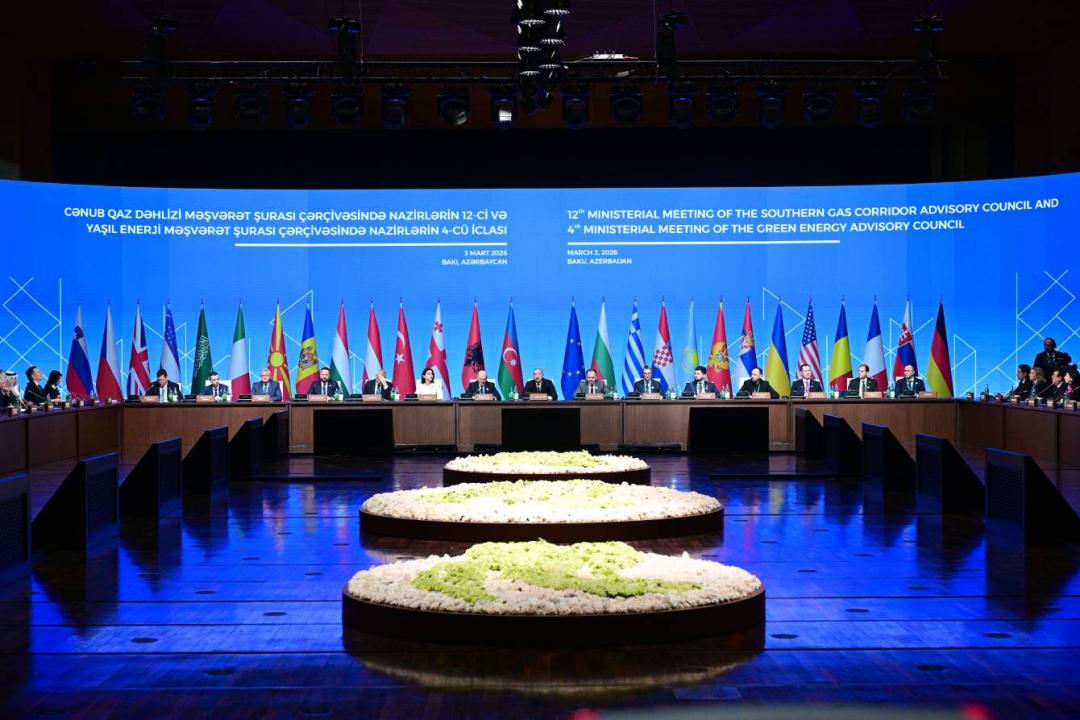
In Baku Convention Center, leaders from 27 countries, EU officials, and energy companies gathered as President Ilham Aliyev and top ministers unveiled Azerbaijan’s growing role as a global energy hub—spanning record-breaking gas exports, pioneering green energy projects, and deepening regional partnerships that promise to reshape Europe’s energy landscape.
Ministerial Meetings
On March 3, the 12th Ministerial Meeting of the Southern Gas Corridor Advisory Council and the 4th Ministerial Meeting of the Green Energy Advisory Council took place at the Baku Convention Center with the participation of Ilham Aliyev, the President of the Republic of Azerbaijan.
Parviz Shahbazov, the Minister of Energy of Azerbaijan, opened the event by welcoming participants, including Dan Jørgensen, the EU Commissioner for Energy and Housing. He described the gathering as another milestone in advancing balanced development between natural gas and renewable energy, as well as in strengthening regional energy connectivity. Shahbazov expressed gratitude to the President for his leadership and invited him to deliver the keynote address.
Addressing the meeting, Ilham Aliyev, the President of the Republic of Azerbaijan, emphasized that the Advisory Council has, for more than a decade, served as a sustainable and reliable platform for cooperation. He noted that Azerbaijani gas is now supplied to 16 countries, compared to 12 a year earlier, making Azerbaijan the leading country globally in terms of the number of states receiving its pipeline gas. He stated that gas deliveries have also expanded beyond Europe, with 1.5 billion cubic meters supplied to Syria to help alleviate electricity shortages. The President underlined that diversification remains essential not only for consumers but also for producers.
Aliyev stated that Azerbaijan has begun supplying gas to Germany and Austria, bringing the number of EU member states receiving Azerbaijani gas to ten. He emphasized that while output is expected to grow in the coming years, expansion of transportation infrastructure is necessary, as the corridor is currently operating at full capacity. He announced that production from the ACG deep gas field is expected to begin this year, while full-scale development of the Absheron field and the second phase of the Umid field will further increase output. A new phase of the Shah Deniz gas field is projected to start production in 2028. According to him, these developments could generate an additional 10 to 15 billion cubic meters of gas at peak production.
Highlighting progress on the green agenda, the President stated that Azerbaijan recently inaugurated a 240-megawatt wind power plant financed by ACWA Power, the largest in the region. He recalled that in 2023, Masdar constructed a 230-megawatt solar power station. By 2032, Azerbaijan expects to generate between 6 and 8 gigawatts of electricity from renewable sources under signed contracts. Aliyev stressed the importance of exporting green energy via planned transmission lines and cables across the Black Sea and from Central Asia to Azerbaijan. He reiterated that fossil fuels and renewables must complement each other, emphasizing pragmatism over ideology in energy policy.
The President also underlined Azerbaijan’s role as a transit country for oil from Kazakhstan and Turkmenistan, noting steady growth in volumes. He stated that Azerbaijan recently acquired an 870-megawatt power plant in Türkiye and signed a contract to build a 500-megawatt facility in Serbia. Additionally, Azerbaijan obtained two refineries in Italy with a combined capacity of 10 million tons, which, together with its 12-million-ton refinery on Türkiye’s Aegean coast, bring total refinery capacity in the Mediterranean and Aegean regions to 22 million tons.
Following the President’s remarks, Shahbazov thanked him and invited Dan Jørgensen, the EU Commissioner for Energy and Housing, to address the meeting.
In his speech, Dan Jørgensen, the EU Commissioner for Energy and Housing, emphasized three priorities: energy security, clean transition, and regional connectivity. He recalled that gas began flowing from Azerbaijan to Europe through the Southern Gas Corridor in 2020, and that after Russia’s war against Ukraine, the EU intensified diversification efforts. Since late 2020, the Trans-Adriatic Pipeline has delivered more than 50 billion cubic meters of Caspian gas to Europe. He stated that the EU’s dependence on Russian gas fell from 45% in 2022 to 12% in 2025 and will decline further. Azerbaijan’s gas supplies, he emphasized, will remain a backbone of European energy security, while the EU will continue as a reliable purchaser.
Jørgensen also highlighted the EU’s renewable expansion, noting that renewables generated 45% of EU electricity in 2025. He called for greater focus on electrification and stressed the role of EU cleantech industries in grid technologies, storage, hydrogen, and cybersecurity. Addressing connectivity, he referred to the EU’s Black Sea Strategy, which promotes energy, transport, and digital integration with the South Caucasus and Central Asia. He emphasized the importance of regulatory convergence, market integration, and sound feasibility studies for cross-border electricity projects.
The meeting gathered representatives from 27 countries, 11 international financial institutions and organizations, and 49 energy companies, including ministers and senior officials. After the opening session, discussions continued in ministerial and plenary formats under the themes "Southern Gas Corridor: Sustaining Success and Driving the Next Phase of Development" and green energy projects. An EU-Azerbaijan Green Connectivity Investment Roundtable was scheduled as part of the program, followed by a press conference on the outcomes of the meetings. The Southern Gas Corridor Advisory Council Ministerial Meeting has been convened annually since February 2015.
Meeting Between Aliyev and Jørgensen
On March 3, Ilham Aliyev received a delegation headed by Dan Jørgensen who was in Baku to participate in the 12th Ministerial Meeting of the Southern Gas Corridor Advisory Council and the 4th Ministerial Meeting of the Green Energy Advisory Council.
Dan Jørgensen stated that he was deeply impressed by the President’s remarks delivered at the opening session of the ministerial meetings. He emphasized the significance of the event and highlighted the importance of the partnership between the European Union and Azerbaijan. Expressing appreciation for the cooperation achieved so far, he conveyed interest in further expanding collaboration.
The President of the Republic of Azerbaijan recalled last year’s visits to Azerbaijan by Kaja Kallas, the High Representative of the European Union for Foreign Affairs and Security Policy and Vice-President of the European Commission, and Marta Kos, the European Commissioner for Enlargement. He stated that the active contacts between the sides demonstrate a strong mutual commitment to deepening cooperation, particularly in energy and connectivity.
During the meeting, both sides emphasized Azerbaijan’s role in strengthening Europe’s energy security under current conditions. They also discussed prospects for broadening Azerbaijan’s energy exports to the European market, including cooperation in natural gas and green energy projects.
Albania Unveils Gas Strategy
On March 3, Erlind Sulo, the Deputy Minister of Infrastructure and Energy of Albania, stated at the 12th Ministerial Meeting of the Southern Gas Corridor Advisory Council and the 4th Green Energy Advisory Council Ministerial Meeting in Baku that Albania is well positioned to secure natural gas supplies through the Trans-Adriatic Pipeline.
He emphasized that access to gas would enable the country to satisfy domestic energy demand, lessen its reliance on electricity as the sole source of energy, and improve the affordability and accessibility of energy for households, businesses, and industrial consumers.
Sulo stated that Albania has opted to advance two parallel initiatives to achieve these objectives. "The first involves the revitalization of the Vlora Thermal Power Plant, which will be implemented as an integrated project connected to TAP's exit point and a floating LNG terminal," he noted. According to him, the second project aims to supply natural gas to the city of Korçë, one of Albania’s principal urban centers.
Montenegro Prepares Ionian Adriatic Pipeline with Azerbaijani Support
On March 3, during the interview with Report, Dino Tutundžić, the State Secretary of the Ministry of Energy and Mining of Montenegro, discussed preparations for the Montenegrin section of the Ionian Adriatic Pipeline, Azerbaijan’s potential involvement, and opportunities for cooperation in renewable energy.
Tutundžić emphasized that the Ionian Adriatic Pipeline (IAP) is regarded as a project of strategic importance, particularly in the context of the ongoing energy transition. He stated that Montenegro has resumed dialogue with Croatia and Albania to move the initiative forward and plans to intensify negotiations in the coming weeks with a focus on regional coordination. He noted that a productive meeting was recently held with representatives of Azerbaijan’s Ministry of Energy, adding that the Azerbaijani side expressed genuine interest in supporting Montenegro’s connection to the Trans-Adriatic Pipeline. According to him, this cooperation presents an opportunity to reinforce the IAP concept, which he described as crucial for both Montenegro and the wider Western Balkans region.
Addressing the development of a domestic gas distribution network, Tutundžić stated that priority must first be given to establishing the necessary infrastructure through the IAP. He emphasized that discussions on supplying gas to industrial and residential consumers can only follow once the core infrastructure is in place. Financing options have already been discussed, he noted, but the immediate objective is to accelerate progress on infrastructure planning and construction. He underlined that constructive cooperation has been established with Azerbaijan, which has signaled readiness to assist with connecting Montenegro to TAP.
Speaking about renewable energy, Tutundžić stated that Azerbaijani investors are welcome to participate in Montenegro’s green energy sector. He recalled that the country organized its first auction last December for the construction of a 250-megawatt solar power plant and plans to hold another auction this year. According to him, the aim is to strengthen Montenegro’s energy balance, expand generation capacity, and improve resilience in the years ahead.
Regarding Montenegro’s commitments to the European Commission and the Energy Community Secretariat, Tutundžić emphasized that foreign investment, particularly from Azerbaijan, would support diversification of the energy mix and facilitate the transition to a more environmentally sustainable model. He stressed that all initiatives must comply with EU standards and contribute to meeting accession criteria by 2028.
He also noted that intergovernmental cooperation between Azerbaijan and Montenegro is already in place, with the next meeting expected in April. This, he stated, will create additional opportunities for dialogue at both institutional and business levels to deepen bilateral energy cooperation.
Referring to Azerbaijani investments in the PortoNovi resort complex, Tutundžić emphasized the potential to expand cooperation beyond tourism and into the energy sector. He stated that a memorandum of understanding with Azerbaijan’s Ministry of Energy may be concluded in the coming months, outlining priority areas for strengthening the partnership in energy.
Kazakhstan Plans to Raise Oil Exports Through Baku-Tbilisi-Ceyhan
On March 3, Sanzhar Zharkeshov, the Deputy Minister of Energy of Kazakhstan, stated that Kazakhstan intends to raise its oil exports through the Baku-Tbilisi-Ceyhan pipeline to more than 12 million barrels annually, equivalent to up to 1.6 million tons per year. He emphasized that cooperation between Kazakhstan and Azerbaijan in the energy sector remains active, particularly regarding the transit of Kazakh oil along this route. "We plan to increase volumes to over 12 million barrels per year. There is potential for growth, and Baku-Tbilisi-Ceyhan is capable of transporting even more – it's just a matter of tariffs. If the tariffs are promising and attractive, then we can always increase our potential," Zharkeshov stated.
He also emphasized trilateral coordination between Azerbaijan, Kazakhstan, and Uzbekistan on the green cable initiative beneath the Caspian Sea. According to him, Kazakhstan sees strong prospects in this undertaking as the country continues to expand its renewable energy capacity. "We see great potential in this project, as Kazakhstan is actively developing renewable energy, and we have more and more projects coming up," he stated. Zharkeshov noted that enlarging the number of participating states is not currently being considered. He added that detailed discussions are scheduled regarding the project’s technical parameters, marketing framework, transit volumes, and tariff structure, while companies interested in implementation have already been identified and the process is advancing.
Zharkeshov further stated that talks were also held on the Southern Gas Corridor. He emphasized that Kazakhstan possesses substantial gas reserves and other exportable resources that could contribute to diversifying energy supplies for international markets. "Kazakhstan has significant gas reserves and other resources that could be exported to other countries to diversify energy supplies. The potential for this is significant, and work in this direction is underway with brotherly Azerbaijan," he stated.