
EU Mission in Armenia: Latest Developments in the Global Realm and Their Consequences for EU-Armenia Relations
The importance of the geopolitical configuration of the South Caucasus has been elevated due to Russia’s weakened position which led to the presence of new actors to the region. Given the lack of the actions and subsequent support from Russia – the strategic ally and security guarantor of many years, in particular the failure of support from the CSTO when Azerbaijan occupied Armenia’s sovereign territories in 2021 and 2022 as well as growing strategic relationship between Russia and Azerbaijan prompted Armenia to seek backing from Western actors.
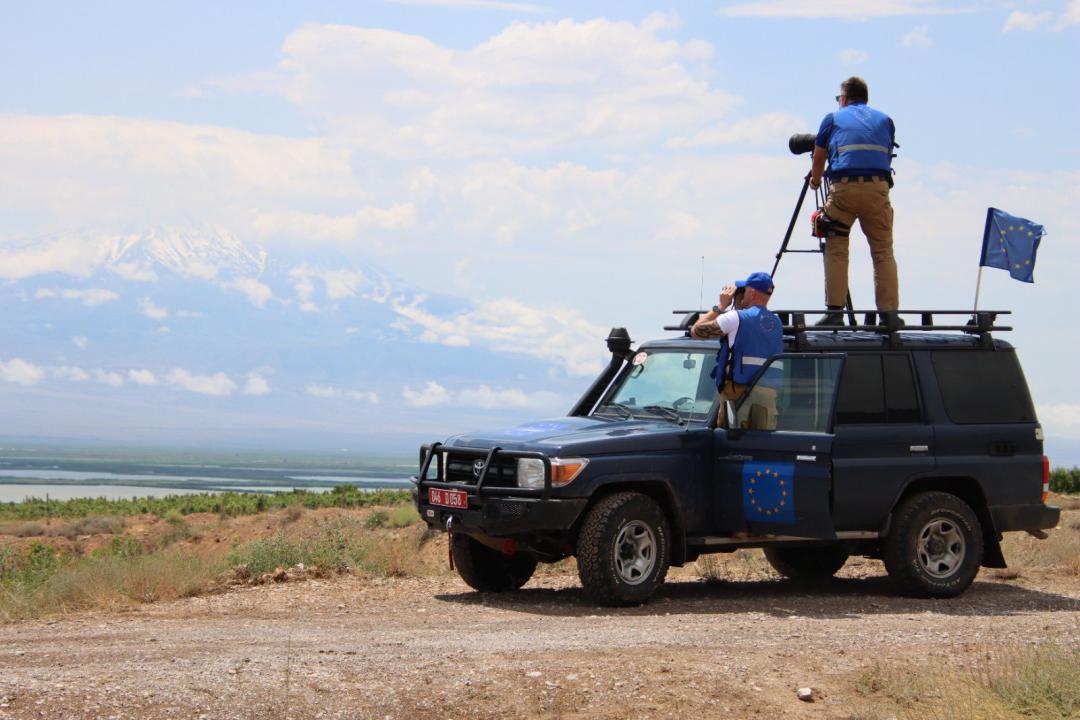
Upon the official request from the Armenian side, the European Council approved to establish the civilian and unarmed European Union Mission in Armenia (EUMA) on the border with Azerbaijan with an initial 2-year duration which now has been extended to 2027. To this date, the Mission has been merely reported the border skirmishes without any intervention as well as held meetings engaging local communities in different regions of Armenia tailored in safety and security of the population and promoting human rights and addressing gender issues. Within the political and diplomatic context, this level of engagement of the EU encompasses deeper security cooperation with the European Union although without projecting military deterrence.
Additionally, EUMA enhanced and deepened its presence in the border by increasing the number of patrols and according to the EU Council’s press release the Mission is a key actor in contributing to the regional peace and stability. At the inaugural launch of Armenia-EU Security and Defense consultations in 2025, Armenian Foreign Minister, Mr. Ararat Mirzoyan also underlined the tangible role of the EUMA in contributing the stability along the border.
Regional Evaluation of the EU Mission in Armenia: Azerbaijan, Russia and Iran
In the regional context, EUMA as the new security actor on the Armenia-Azerbaijan border shifted the political narrative. On contrary, Azerbaijani high officials repeatedly expressed dissatisfaction on EUMA’s presence on the Armenia-Azerbaijan border as they considered the activities of the Mission as “contradicting the initial agreements with this mission and activities” and calling it as a “anti-Azerbaijani propaganda tool” in Armenia provided that the mission is deployed merely in Armenian territory and the monitoring results can be biased, although Azerbaijani side have not show willingness to cooperate with EUMA.
In addition, the same anti EU narrative was developed by the Russian high officials and was circulated in Russian media outlets. Nevertheless, Russian Maria Zakharova, the spokeswoman for the Russian Ministry of Foreign Affairs, called the mission as a “spying organization” that is designated to spy the bordering countries – Iran and Azerbaijan as well as Russia.
Both Azerbaijan and Russia targeted the Armenia’s path towards the European initiative by diluting the role of the EUMA in the region. Russian side aimed to remain as a strategic actor and a “geopolitical mediator” in the Armenia-Azerbaijan conflict and for that reason began propaganda tailored against EU politics. Pursuing a common goal, Azerbaijan diluted the role of the EUMA which has motives to enhance Armenia’s defense sector.
What is more, Dr. Stefan Meister, Head of the Center for Order and Governance in Eastern Europe, Russia, and Central Asia at the DGAP highlighted that EU member states also support Armenia in training border forces and developing defense capabilities and EU will provide greater assistance in countering disinformaiton and hybrid threats within the scope of the Armenian parliamentary elections in the upcoming year.
Evidently, it is important to note that the number of the border incidents has been gradually decreased which is related Armenia’s foreign policy, negotiations with Azerbaijan as well as the deployment of the EUMA according to the head of the EUMA Marcus Ritter.
When it comes to Iran’s stance on EUMA’s deployment in the region, initially Iranian high officials did not have optimistic outlook concerning the Mission’s role considering it as involvement of foreign powers in South Caucasus. Nevertheless, due to the diplomacy and constant negotiations, Iran changed the overall perspective on the EUMA. In this respect, the Iranian Ambassador to Armenia Mehdi Sobhani that the Iranian government regards the extension of the Mission’s mandate positively and acknowledges Armenia’s diversifying foreign policy.
What is the future of the EU Mission’s role as a third party amid the latest deal brokered by Trump?
The peace deal brokered by the US President signed by Armenia and Azerbaijan in August 2025 raises some questions about the interpretation of the clause that explicitly bans the deployment of the third party forces on the border.
The clause does not specifically define “third party forces”: given the broad interpretation of the wording, it is challenging to define In fact, the clause can be referred to the Russian former peacekeeping in terms of deploying military forces. Although, EUMA operates without military envolvement within civilian framework, its presence can be challenged by several external factors.
In reference to the future of EUMA, Mr. Meister asserted that the possible outcome can be the withdrawal of the EUMA or the EU can opt for an alternative of repositioning its deployment further from the border, in the meantime still monitoring all the actions in proximity to the border. Nevertheless, Mr. Meister outlines that Baku advocates the withdrawal of the EUMA which even can be a precondition of the peace treaty for the final signature. Mr. Meister is convinced that this does not imply that Armenia jeopardizes its relations with the EU, provided that Brussels fully understands the context and does not consider Armenia’s actions to be contrary to EU foreign policy but a pre-requisite factor for an anticipated conclusion of the peace treaty.
Apparently, there are plenty of other areas of cooperation which will further go on and as long as the Armenian government is staying on a democratization track, there will be no alienation. Mr. Meister summarized that a functioning peace treaty between Armenia and Azerbaijan would obviate the need of the monitoring mission deployment on the border. Provided that the role of the EUMA is limited by observing the border as well as the mission is designated to maintain stability develop confidence among the local communities, the function of a “regional monitor” would not be relevant.
About the Author: Emma Ghalumyan has over three years of experience working on EU-funded projects and in consular affairs. She has held roles at the Central Project Management Agency and the Embassy of the Hellenic Republic to Armenia, contributing to consular affairs and project implementation. Emma holds an LL.M. in International and European Law with a specialization in EU Law.
Insights,
Politics,
Armenia, Azerbaijan |
Russia, Iran, CSTO, Stefan Meister, Armenia-Azerbaijan Relations, EUMA, Mehdi Sobhani, Emma Ghalumyan