
“Only Not a New War”: Life in Armenia’s Syunik Province
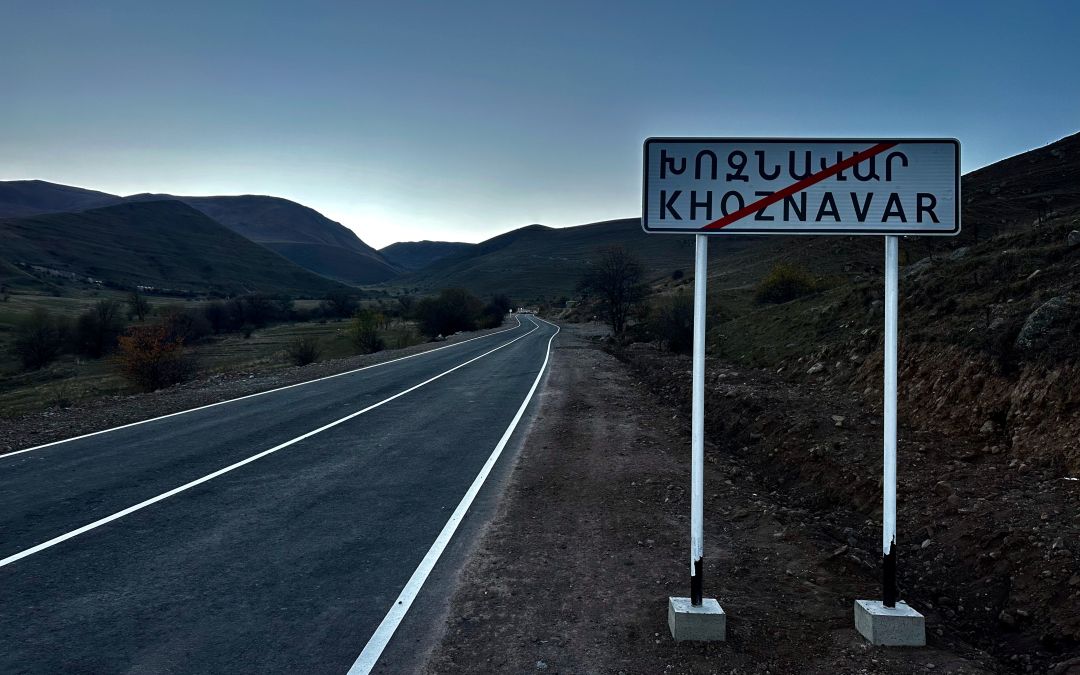
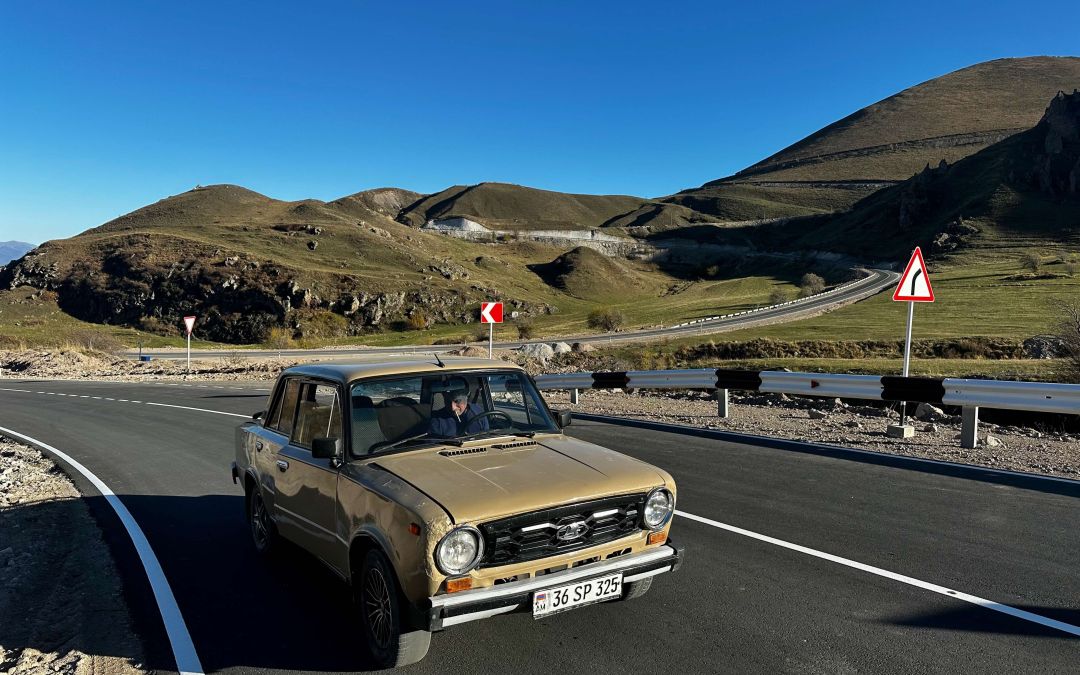
Just three months ago, Armenian media reported on an almost daily basis on shootings in the villages of Khnatsakh and Khoznavar in Armenia's Syunik province, bordering with Azerbaijan. Both sides accused each other of provocations and opening fire first. However, today it seems that the situation has calmed down, and the locals themselves say that they have not heard a single gunshot since the Washington meeting. At the same time, they are quite skeptical about its durability.
The autumn sowing campaign has been launched in this province. On both sides of the highway leading to these “sibling” villages, the fields shine green and black under the autumn sun. On a hill opposite, a large Armenian flag flutters. "It is 34 meters high, in memory of the 34 soldiers from our community who died in the 2020 Karabakh war," the driver explains. However, on October 9, an official flag-raising ceremony took place on Urtsasar hill , during which the head of the Tegh community, Davit Ghulunts, said that it is the largest flag in Armenia and that its 34-meter height symbolizes the 34th anniversary of the independence of the Republic of Armenia. Ghulunts stated: “After August 8, we can say that our community began to live. Before that, every day here was tense. When the peace treaty (a joint Declaration) was signed in the United States of America on August 8, I climbed this hill and the idea came to place a big flag on the hilltop. From here, you can see the whole of Syunik, the Artsakh (Karabakh) mountains are also visible”.
It's quiet in Khnatsakh; sometimes a car passes by, the owner of which looks at the newcomers in surprise, leaving a cloud of dust behind him. In general, being here, one gets the impression that it's a different world, as if this isn't what's being discussed in the Armenian media. It gives a strange silence and a feeling of emptiness. Only a boy is scrolling TikTok inside the "shelter" of the kindergarten yard, and an old man is sitting on a bench. When he saw me, he joked: "Are you coming from Karabakh?". He then asked seriously, “What day of the month is it today?”. Knowing the date, he said that today he is exactly 80 years and 11 days old and is ready to take all my questions. He explained: “I have two first names: on my passport is written Misha, but in the village, everyone calls me Valod”.
“If they do something, they do it well”
In the center of the village where grandfather Misha-Valod is sitting, a large poster with the logos of GIZ and the EU hangs. The first thing you notice about the village is the rocky and dusty roads. One might assume they're being renovated, but Misha-Valod explained that authorities are currently funding the replacement of the water supply system. A man who joined our conversation then remarked on the efficiency of the Europeans, saying: "We Armenians, at least, know very well ourselves. First, we would lay asphalt, then we would demolish it, dig it up, and then we would lay the water pipes, thus turning one task into two. Haven't you heard that anecdote from the soviet years? There are three workers: one digs a hole, the other installs an electric pole, and the third pours cement concrete. So, one day the pole installer doesn't show up for work, the other two continue their work: one digs a hole, the other fills it with cement without installing the electric pole. 'The important thing is that we do our job!', these two say. But if these Europeans do something, they do it well, not like us".
Another vehicle that left a cloud of dust was the EU Monitoring Mission's Toyota. The same man, who was just 'complaining' about the Armenian builders, said: "I find their presence here is really important. I say this as someone who has seen all the wars. Sometimes binoculars are a more effective 'weapon' than a Kalashnikov. I am sure that if by some miracle they had been in Nagorno-Karabakh and not the Russians, the picture would have been completely different". He added, sighing: “Anyway, it's peaceful for now; let's see how long this peace will last, let's see what happens in this country after the 2026 elections”. Like the Armenian media, people in society also have opposing views on lasting peace in the region. While I was traveling to Khnatsakh, two women were discussing the topic of peace and war during the transport: "Today there was a meeting with the Europeans in Goris, they promise there will be peace, but how do they know that, who can guarantee it? If they promise us peace, then why can't they achieve it in Ukraine?". The Goris women may continue to discuss the Ukrainian crisis, but it's hard not to agree with this villager that when Europeans do something, they do it well.
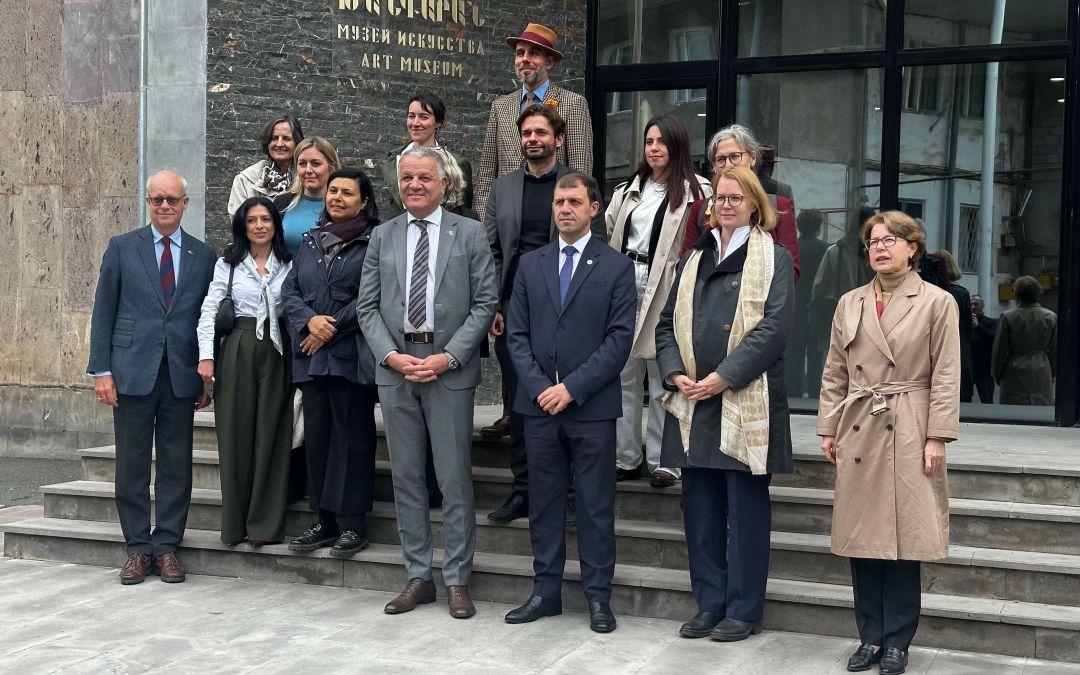
On October 16, a media tour was organized for Armenian journalists during which they had the opportunity to get acquainted with the projects and activities of the Resilient Syunik Team Europe Initiative. These include a Healthy Aging Center in Goris for seniors (including those displaced from Nagorno-Karabakh) , green agriculture , a Youth and Children’s Creativity Center in Kapan , a new water supply system that serves more than 3,000 residents and 50 hectares of farmland, boosting agriculture and strengthening food security for local farmers , and the French funded Santé Arménie rehabilitation center, where hundreds of adults and children receive free neuro-orthopedic care close to home. These are all successful and implemented projects, and the good news is that such initiatives will be ongoing. During this media tour, Ambassador Vassilis Maragos told reporters about 2.6 or 2.5 billion euro assistance. Maragos stated: “As for the 2.6 or 2.5 billion euro assistance, this is indeed a very important commitment that the EU undertook at the beginning of 2021. In mid-July, there was also a summit and a leaders’ meeting. Armenian Prime Minister Pashinyan visited Brussels and met with European Commission President Ursula von der Leyen and European Council President Antonio Costa. During that meeting, they announced that the investments being implemented in Armenia would reach 2.5 billion euros. And these are projects that have either already been carried out or are currently underway. For example, the construction of the Sisian-Qajaran highway, including the tunnel, is part of this initiative. These are all investments that we are implementing from the EU budget, loans taken by the Armenian government, as well as from other partners within the framework of the Team Europe program”. The European Union also announced 5 million euros investment to strengthen nuclear safety in Armenia.
“Only not a new war”
On the road leading to Khoznavar village, a worker sweeps autumn leaves from the newly laid asphalt with a diesel street sweeper, while another draws a white dividing line. The first sign upon arriving in the Khoznavar village is Narin’s kiosk, where she sells groceries to fellow villagers. During the first Karabakh war in the early 1990s, her parents took her to this village for safety, where she got married and lives here to this day. "I didn't have a childhood; at least my children and grandchildren should have one," she says. As a teenager, Narin was carrying water home from a spring in her native village of Kavahan in the Martuni region (Gavahın, Khojavend District), in Nagorno-Karabakh when she heard the sound of a fighter jet in the sky, which she said was dropping cluster bombs. Narin recalls: “Many probably would remember that soviet enameled 4-liter cans that everyone had at home. I was on my way home holding two of them filled with water when they dropped a cluster bomb. I stood frozen with my eyes closed. By that time, we had already heard the news of my brother's disappearance; I began to pray. 'God, let me only hear some news from Meruzhan, then I can die'. When the sound of the fighter faded away, I opened my eyes and saw 4-5 meters away from me a mother pig with piglets disemboweled and bloodshed. It was as if my feet were glued to the ground, I couldn't take a step”.
After the 2020 44-day war in Nagorno-Karabakh, the fate of 172 Armenian soldiers is still unknown, and 19 civilians are not on the list of victims or war prisoners. According to official data, 777 Armenians remain missing since the First Karabakh War, while Azerbaijan reports that nearly 4,000 are missing from the conflict. Narin's brother Meruzhan went missing during the first Karabakh war. She says that 5 years after her brother's disappearance, they received a call from Azerbaijan, where someone called his name in Azerbaijani language and asked: “Petrosyan Meruzhan Gurgenovich?”. But the connection was lost and no further news about his fate has been heard to this day. She says: "After receiving that call, we believed that he was still alive, but we don't know what happened after that".
The first Karabakh war coincided with the year of the collapse of the Soviet Union. Narin's brother Meruzhan was called up to the military commissariat to serve in the Soviet army, but he returned home after three days. Thinking that he had evaded military service, his father Gurgen decided to find out the circumstances at the military enlistment office. Meruzhan later explained: “It was 1991, he came home and said: 'Dad, I'm not lying, they said there's no army, no Soviet Union anymore, go home'. Anyway, battles were already underway in Karabakh, and self-defense units were being created, and everyone was voluntarily registering there. 'Dad, everyone is registering, I must also voluntarily register,' said Meruzhan". His father was opposed, telling him: “Son, it’s a well-said word, the wolf eats the alone lamb, you are the only boy in our family. Look, Andrey has seven sons, it is possible that no misfortune will happen to them, but to you, a random bullet could hit exactly you. 'If it's my fate, so let it be,' my brother responded". At that time, fierce battles were taking place in Mataghis and the unit where Meruzhan registers was taken there.
Days later, a soldier came and called my father, Gurgen, saying: “Gurgen, come here I have something to tell you”. He informed my father that the unit was gone: “half of them had died, and there was no news about the other half, perhaps they had been captured, perhaps they were under siege, perhaps they were wounded, we don’t know. They had brought many corpses to the Martakert morgue, let’s go, see who you can recognize,” he told to my dad. I was secretly listening to their conversation from the window. “Over, my home is destroyed,” said my dad. I went under the blanket and started crying. After that, my father and mother began searching for my brother in the forests where the battles had taken place. They searched from August to November, but in vain. I didn't recognize my father when he came home; his beard had grown to his waist. At that time, the Armenians had taken an Azerbaijani prisoner, whose brother was the head of the local KGB department. Since he was the brother of an official, we had high hopes that we would be able to exchange him for my brother. We kept the Azerbaijani prisoner in our home for five years. He had almost become a ‘member’ of our family. He would even take the donkey and go to the forest alone to fetch firewood.
One day, the Red Cross came and said that the Azerbaijani’s brother was offering a lot of money, just let him go. My father said: “I am not selling my son for money, I only want to exchange this Azerbaijani for my son. Even if you bring my son’s body, even if I find out that he was killed and I will hand over this Azerbaijani to you, I don’t want a single penny, I want my son”. Despite this, the Red Cross took that Azerbaijani to Azerbaijan. In the morning, we learned that the Azerbaijani was no longer in our home. My parents ordered me to sell the cow if a buyer came to the village, and they went back to look for Meruzhan. She tells confused: “How could a 13-year-old girl make such a ‘deal’? I milked the cow as best I could, as if I had matured by 10 years”.
Narin burst into tears, not when she told the story of her missing brother, but when she recalled her childhood. Traditionally, unmarried women in Nagorno-Karabakh were forbidden from entering the bakery (tonir), as the fire would wrinkle their skin, and they had to preserve their feminine beauty until marriage. The traditional Armenian bakery is a large clay pit at ground level, and women baked bread on their knees. She says, wiping away tears: “My grandmother was already old, she had prepared the dough, but I was baking in the tonir. She held my back; I bent over and baked. It was not childhood, but a nightmare”. She continues: "Now, I already have grandchildren, when I see some parent getting angry with them, I forbid them. Let them spend their childhood, I say. I was deprived of childhood, I didn't forbid my children anything, whatever event is happening in the village today, I let them participate, play".
She reflects: “Looking back, our grandfathers saw wars, we saw them, our children saw them, and our children are seeing them today. Yes, it's peaceful now, but who can predict what will happen in the future?”. She explains the economic reality: "You know, our village is right on the border, people here were mainly engaged in animal husbandry, but after the 2020 Karabakh war, pastures have decreased. It's very risky when the situation gets tense. We had about 200 sheep, but since there is no space to keep them, we sold them. People don't know what to do in Khoznavar, only potatoes and beans grow here. When the situation calms down, there are no shots, the villagers start buying sheep and cows. When the situation gets tense, they start selling them; they don't know what to do”. Narin concludes: “These memories cannot be erased; I don't want the new generation to face the same thing. If everything remains as is, it’s still okay, as long as a new war doesn't start and the new generation doesn't grow up and sees another war. It's peaceful for now; let's see how long this peace will last”.
Contributed by Marut Vanyan.
Insights,
Politics,
Armenia, Azerbaijan, Nagorno-Karabakh |
EU, International Committee of the Red Cross, Syunik, EUMA, Karabakh War, Marut Vanyan