
Reshaping South Caucasus: New Realities and Shifting Power in 2025
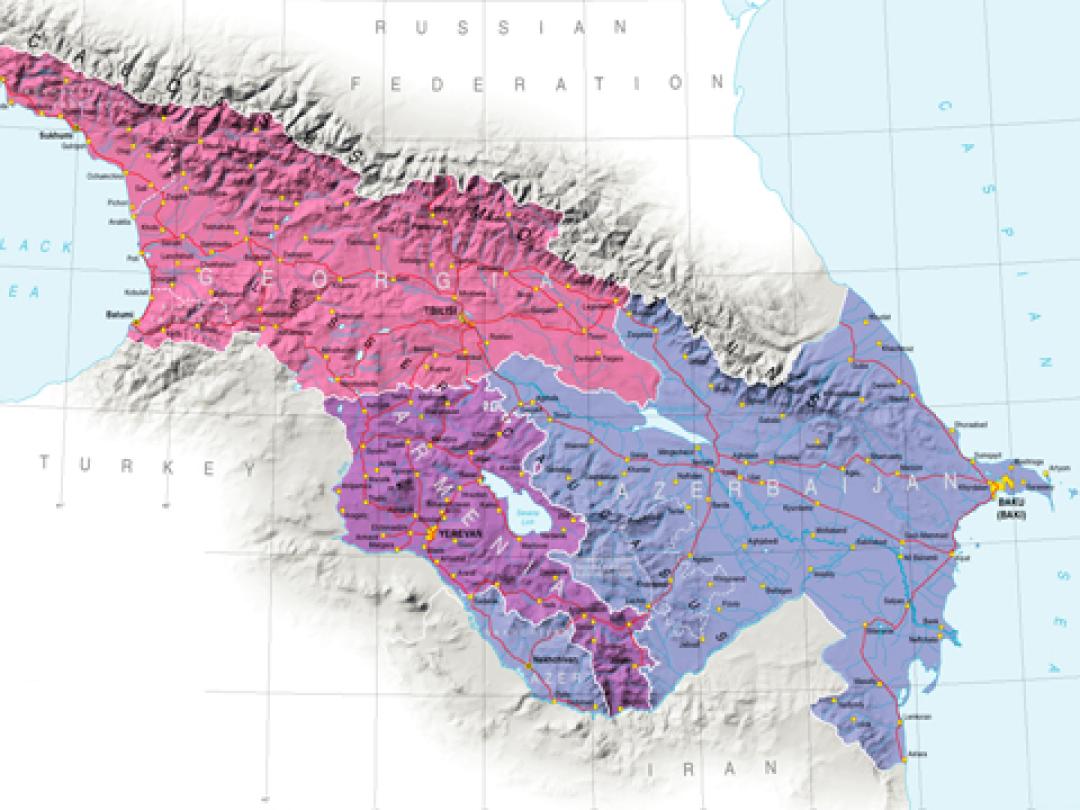
The South Caucasus in 2025 finds itself in the process of reconfiguration and reshuffling. What appeared in the past as either a region in limbo and hamstrung by unresolved conflicts and entrenched geopolitical rivalries has now commenced a transition into a much more dynamic and complex, multi-aligning order. The latter strategic recalibration has in no way been triggered by a single breakthrough or by the action and initiative of any formerly pivotal force. Rather, it has emerged from the cumulative effect of the South Caucasus in the post-Karabakh environment, the erosion of old security frameworks, transactional alliances, and the realignment of external powers whose priorities have transformed since 2020.
Initiatives such as TRIPP – the U.S.-brokered geoeconomic framework for conflict management demonstrate how targeted, incentive-driven diplomacy is supplementing traditional multilateral approaches, creating opportunities for bilateral progress on issues like corridors and border access. The South Caucasus in 2025 signifies, in these terms, a region in transition and flux.
The political unfoldings within Armenia offer a typical example in this regard. After years of pinning hopes on Russian security guarantees, in 2025, there was a radical transformation in the foreign policy vision in Yerevan. The loss of Nagorno-Karabakh, the withdrawal of Russian peacekeeping troops, and the inability of Moscow to uphold even symbolic obligations forced Armenia to reassess its foreign policy orientation. Moscow’s focus on Armenia is primarily shaped by how Western powers engage the country, but new dynamics are shifting influence toward Ankara and Beijing.
Armenia has strengthened ties with Turkey over the past two years, and as negotiations with Azerbaijan proceed, Ankara appears increasingly open to normalizing relations with Yerevan. At the same time, Armenia has elevated its relationship with China to a strategic level. This effort for diversification of alliances reduces Armenia’s historical reliance on Moscow and challenges Russia to adopt a more flexible and nuanced approach in its regional approach.
The Armenian government intensified cooperation with the European Union, India, the United States, and a set of emerging security partners. In addition, TRIPP in particular offered Armenia a structured pathway to engage with Azerbaijan on corridor and transit issues, complementing broader diplomatic actions. These initiatives included negotiations on border delimitation, multiplication of defence assistance, and attempts to build a new political-economic landscape that reduces the existing overialince on both Russia and Iran.
Despite all, the Armenia-Russia reciprocal relationship still goes on in terms of practical cooperation, through diplomatic talks, trade, and defense-technology collaboration in the conventional and nuclear fields. Yet, big moves, like the withdrawal from CSTO, would be difficult in the short run. Both sides exercise caution, and Russia’s attention remains absorbed by the war in Ukraine, keeping their relationship largely transactional and limited. Looking ahead, the Armenian side has to walk a tightrope, on the one hand in its interaction with Moscow and on the other in its path forward to ensure close ties with Europe, making Russian influence in the region important, albeit no longer unchallenged.
Azerbaijan began the year in a strong geopolitical posture. The re-establishment of territorial integrity in 2020 and 2023 permitted Baku to prioritize longer-term regional integration and energy politics over conflict management. For Azerbaijan, a multi-aligned approach has become central to its regional strategy. Baku is actively building resilience against potential Russian pressure by strengthening partnerships with Turkey, Central Asian countries, Pakistan, Israel, the U.S, the EU, and Ukraine, while leveraging its energy resources and infrastructure projects to secure strategic vitality.
The TRIPP process embodied the Azerbaijani foreign policy ethos, whereby Baku made transactional offers and performed actionable services, making slow progress toward corridor development and bilateral initiatives even in the absence of a broader peace. Baku and Armenia engaged in on-again, off-again peace talks through much of 2025, driven by formal agreements and a blend of bilateral and internationally led facilitation. While those talks led to some gains in border and transit issues, the absence of a broader peace was a reminder that the shadow of conflict has still not passed.
It should be noted that even now, Russia retains tools to exert influence, such as economicE measures and control over the transit routes (like the INSTC, away from Azerbaijan toward Central Asia or Georgia), but Azerbaijan has largely absorbed these risks without yielding on key policy directions. Azerbaijan’s pursuit of a principled hedging and balancing foreign policy provides it with an advantageous buffer against potential pressure from Moscow. The two-sided interrelation is therefore characterized by pragmatism; Moscow and Baku maintain a calibrated mix of interdependence and autonomy, signaling the shift away from post-Soviet hierarchical control toward a more adaptable and situational regional order.
Georgia’s situation is more complicated. The country remains a crucial transit corridor and a pivotal partner sought by both Western and regional actors, yet domestic political backslidings and the critical unfoldings within Caucasus connectivity have introduced new vulnerabilities and risks. Historically, Tbilisi pursued a Western-oriented trajectory centered on EU and NATO integration. Yet the reversion toward a limited strategic autonomy and amorphous form of pragmatic multivector foreign policy, reflecting contested attempts at hedging and balancing among competing powers, means Georgia now struggles to maneuver within the multipolar, competitive order of the region.
This cautious deviation and misaligned approach toward a Eurasian camp carries strategic risks, as it could further erode traditional Western commitments and the country’s long-term foreign policy trajectory. At the same time, discussions about alternative routes, including those incentivized under frameworks like TRIPP, create concerns and fears of a reduction in Georgia’s strategic relevance. The domestic political scene is heavily polarized, generating mixed signals for external partners and weakening the internal consensus needed to respond to regional realignments. Its long-term position will hinge on whether it manages to reverse its current path toward the abyss to avoid drifting further into strategic irrelevance and regional marginalization.
The erosion of traditional security arrangements has affected all three states in different ways. The role of Russia has continued to wane, partly due to the war in Ukraine and partly because regional actors have grown accustomed to operating without its approval. Moscow’s authority, once grounded in the assumption that it could restrain conflict while providing political leverage, has largely collapsed. Despite this, Russia draws on certain levers, particularly energy routes and intelligence/military partnerships, though these are far less decisive than before.
Together with Russia, Iranian policy reflects anxiety over TRIPP and strategic bypassing, asserting influence through diplomatic warnings, economic signals, and military displays near its northern borders. Yet, all these still do nothing much to alter the general position that Iran finds itself on the outside in terms of the primary decision-making in the South Caucasus in 2025.
In this geopolitical context and shifting regional status quo, Azerbaijan, bolstered by Turkish military and Israeli intelligence backup, and emboldened by post-Karabakh confidence, now positions itself as an emerging regional power, endowed with significant defensive and offensive capabilities and strengthened by strategic security guarantees linked to its critical natural resources.
Economic transformation introduces an additional layer of complexity in terms of region-wide shifts. The South Caucasus region observes the growing role of digital integration, logistics modernization, and energy diversification. Armenia attempts to rebrand the country itself as a technology and services hub, Georgia continues to enhance its Black Sea trade role, and Azerbaijan further aligns its energy exports with its national and economic grand strategy.
Transactional projects like TRIPP reinforce economic interdependence by linking corridor management and transit improvements with investment and development objectives. The region’s economic growth in 2025 is moderate, with projections of 3–4% GDP growth for Georgia and Azerbaijan and slightly lower for Armenia, driven by exports, trade, and parallel economic expansion.
Collectively, these developments suggest that the South Caucasus is experiencing a profound structural transformation. No longer constrained by frozen conflicts or shaped solely by externally imposed frameworks, the region has become a dynamic space where diverse models of security, power projection, and regional governance are actively tested and bargained in the light of a transitional multipolar world.
Rising middle powers, established actors, and locally assertive states continuously engage in cycles of situational calibrations, realignment, and strategic uncertainty, producing a competitive and contested landscape. The latter evolution signals the emergence of a more transactional and malleable regional order, dictated by patterns of regionalism and shifting alliances.
Contributed by Luka Okropirashvili for Caucasus Watch
Insights,
Politics,
Armenia, Azerbaijan, Georgia |
EU, NATO, China, South Caucasus, Russia, Turkey, Central Asia, USA, India, TRIPP, Luka Okropirashvili