
Shaping Armenia’s Long-Term Policy for Refugee-Like Communities
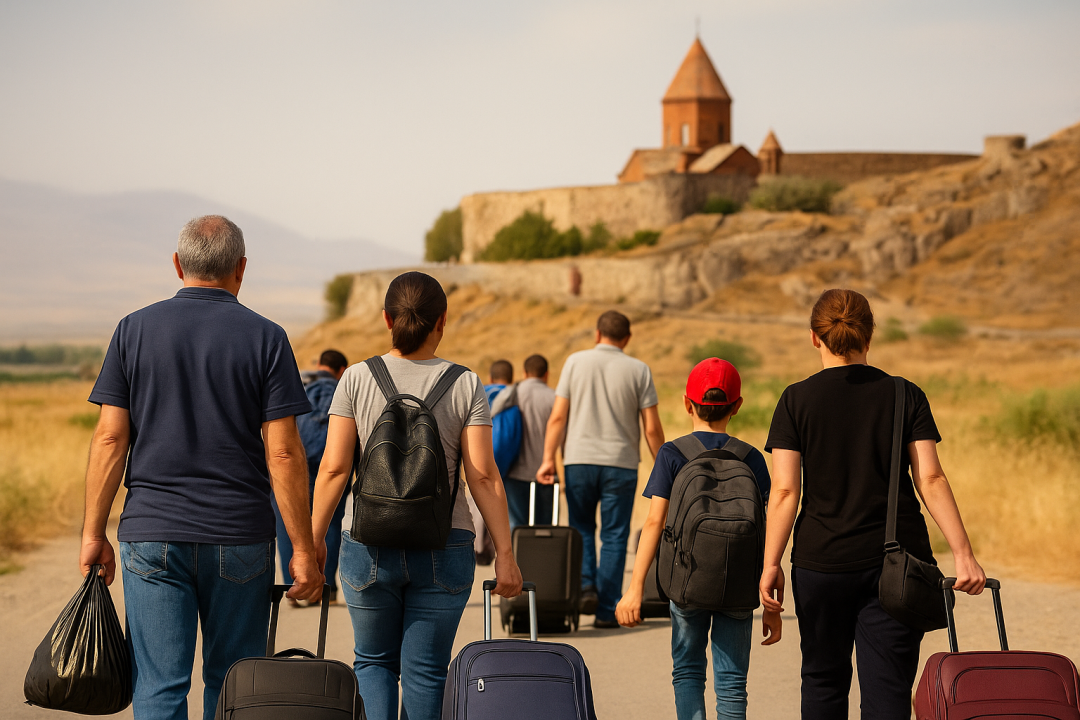
In September 2023, more than 100,000 Armenians from Nagorno-Karabakh crossed into Armenia. It was one of the fastest mass displacements in recent European history. Entire communities left their homes within days. They arrived as refugees, but not in the legal sense, as they are considered forcibly displaced people from Nagorno-Karabakh and are given temporary protection status — marked by sudden displacement, loss of homes, and the urgent need to rebuild lives in unfamiliar settings (ARLIS.am). Their challenges were just as significant: securing housing, finding jobs, enrolling children in schools, and adjusting to a country already struggling with unemployment and demographic decline.
The immediate humanitarian response was swift. Yet the bigger question is what comes next. Can Armenia transform this crisis into a long-term strategy that benefits both refugee-like families and the country as a whole? As Tigran Jrbashyan — Partner & Director of Management Advisory Services at Ameria CJSC and Strategic Advisor on Economic Reform — explained: “This is not just a matter of assistance. It is about integrating refugee-like policy into Armenia’s broader demographic and economic development agenda.”
The labor market shows the scale of the challenge. Jrbashyan estimates that the number of employed people decreased by 284,000 people during the last two decades, with another 100,000 at risk. About 185,000 people are employed but poor, most of them in agriculture. Nearly 340,000 are considered as underutilized labour, neither working nor seeking work.
Official figures confirm the trend. Unemployment stood at about 12.4% in 2023 (Armstat), slightly down from 13.5% the year before. Yet agriculture still accounts for more than half of employment (CEIC Data, Trading Economics), a far higher share than in comparable economies. The World Bank also reports that nearly two out of five working-age Armenians are outside the labor force (World Bank Overview). “We don’t have a shortage of people, we have a shortage of opportunities,” Jrbashyan said. “The real conflict is not about numbers, but about the mismatch between what the education system provides and what the economy requires.”
One way forward, he argues, is decentralization. Armenia’s economy remains heavily concentrated in Yerevan, while regional towns and cities struggle to attract investment. Creating industrial zones in communities that include regional cities could generate jobs, draw investment, and give refugee-like families the chance to rebuild outside the capital. “If we continue to centralize everything in Yerevan, the regions will remain empty, and displaced people will have no real path to rebuild their lives in the agricultural settlements similar to those they previously inhabited,” Jrbashyan warned.
Housing adds another layer of urgency. While temporary accommodation was provided, Armenia still lacks a long-term housing strategy. International lessons are telling. In Abkhazia, large complexes built exclusively for displaced persons left them segregated from local communities. Armenia should avoid this outcome by promoting mixed housing models, where refugee-like families live alongside locals, sharing schools and services. This approach fosters integration rather than dependency.
Education reveals a similar divide. Schools in Yerevan are overcrowded, while many regional schools remain underused and underfunded. For refugee-like children, who were forced to move to Yerevan with their families because of low employment opportunities in the regions, this creates an uneven playing field: crowded classrooms in the capital versus limited quality in the provinces. But there are lessons to borrow. In New Zealand and Australia, regional schools specialize in STEM, vocational training, and cultural education, linking learning directly to local economies. Armenia could adapt this approach, creating regional education hubs that serve both refugee-like and local youth while addressing the country’s wider skills gap.
Language is another challenge. Many of the forcibly displaced people— especially older generations — struggle with dialect or standardized Armenian in schools and workplaces. Without targeted support, these barriers limit access to jobs and services. In Europe, language and civic integration programs are standard in displacement policy. Armenia could adapt similar initiatives to help refugee-like citizens integrate more quickly and fully.
All these issues intersect with Armenia’s demographic outlook. In October 2024, the government approved the Demographic Strategy for 2024–2040 (UNFPA EECA). The Strategy aims to strengthen human capital, improve healthcare, and support family well-being while reversing negative trends such as low fertility and youth outmigration. By linking refugee-like policy with this strategy, Armenia could transform displacement into an engine for revitalization — stabilizing population patterns, stimulating regional growth, and supporting inclusive development.
Armenia is not alone in this struggle. Georgia has passed a law on internally displaced persons, combining housing, property restitution, and integration measures. Colombia created one of the world’s most advanced frameworks in 1997, Law 387, which sets clear state responsibilities for registration, housing, and durable solutions. Uganda’s National Policy for IDPs (2004) is praised for granting displaced people the right to work and access land, helping them achieve self-reliance. The principle behind these cases is clear: effective refugee-like policy requires strong laws, capable institutions, and sustainable financing.
Displacement should not be seen entirely as a burden. With the right choices, it can become an opportunity for reform. Armenia’s underlying challenges — unemployment, dependence on agriculture, weak housing, centralized education, and language barriers — affect both refugee-like and local communities. Tackling them together makes sense.
If Armenia invests in regional industrial zones, promotes inclusive housing, builds specialized schools, launches language programs, and aligns these measures with its demographic strategy, it can turn displacement into a driver of long-term growth. As Jrbashyan concluded: “If we make the right choices now, refugee-like policy can become part of Armenia’s long-term growth strategy, rather than a temporary response to crisis.”
Contributed by Siranush Grigoryan