
The South Caucasus’ Moment of Peace
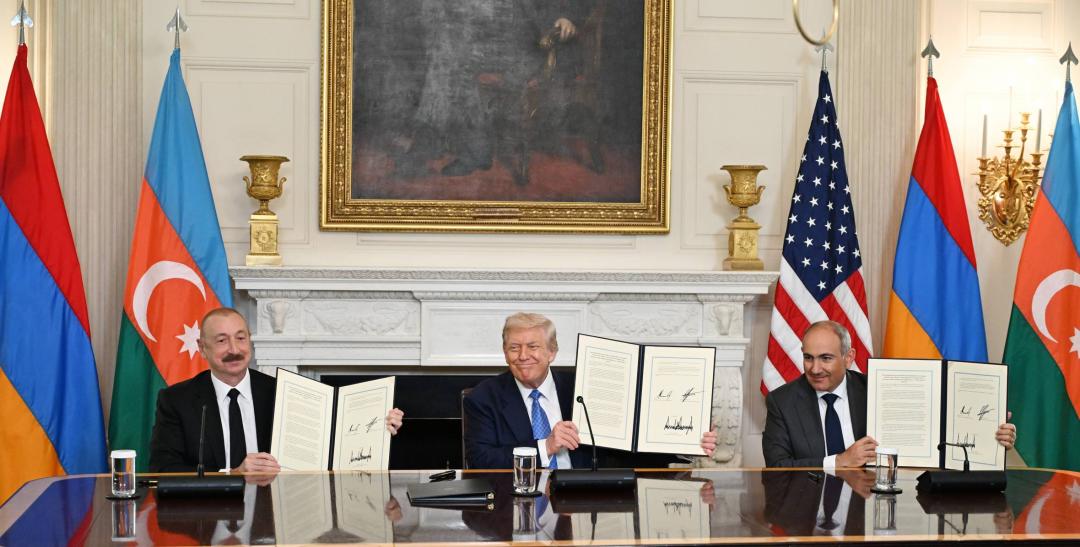
The TRIPP might be symbolic in many ways, but it nevertheless signals a shift in the geopolitics of the South Caucasus, especially for Iran and Russia.
Iran’s foreign policy toward the South Caucasus has transformed over the 2020-2025 period. From the end of the Second Nagorno-Karabakh War to the signing of the TRIPP agreement between Armenia and Azerbaijan in August 2025, the status quo that prevailed in the South Caucasus since the 1990s has been completely shattered. In the span of five years, Iran has been adjusting to a swiftly changing geopolitical environment.
A stronger Azerbaijan, a weaker Russia, a more emboldened Turkey, and a plethora of other players such as China, the EU, the US, and even the Arab states of the Persian Gulf—this highly congested geopolitical reality in the South Caucasus is a historically new development for Iran, which traditionally has only had to contend with Russian and Turkish powers.
In the latest example of a changing geopolitical environment for the Islamic Republic, Washington D.C. became the stage in August for a high-profile meeting between the leaders of Armenia and Azerbaijan. The most consequential outcome was the signing of the “Trump Route for Peace and Prosperity” (TRIPP). The agreement envisions a transit link that would connect Azerbaijan with its Nakhchivan exclave by running across Armenia’s Syunik region. If realized, the project could reshape the security architecture in the region. Moreover, given the shifts in global commercial routes, the TRIPP could also reshape how trade corridors in the South Caucasus work. This is bound to impact Iran’s standing.
Tehran quickly signaled its unease after the summit. Iran’s Foreign Ministry cautioned against foreign meddling near shared borders, reflecting a long-held suspicion of external involvement in its northern neighborhood. Since the early 1990s, Azerbaijan has relied on the Aras Corridor running through northern Iran to maintain access to Nakhchivan, a route reinforced in 2023 through new Baku–Tehran agreements aimed at expanding the transport infrastructure at the time. Should the TRIPP take shape, Iran could lose both lucrative transit revenues and a critical instrument of leverage over Baku. Iran’s concerns are based on the idea that any plan that might alter regional borders or limit Armenia’s sovereignty would by default weaken Tehran’s position as well.
No wonder then that the Islamic Republic has always resisted the so-called Zangezur Corridor (referred to in Armenia as the “corridor” or “Syunik corridor”), backed by Azerbaijan and Turkey, which envisioned an extraterritorial passage across Syunik. For Iran, Armenia is important as its territory provides its only reliable land link into the South Caucasus, a corridor that also offers access to Georgia’s Black Sea ports and, through them, to the European market.
Iran has traditionally applied a concept of regionalism to the South Caucasus. This idea involves obstructing any non-regional presence in the area. From Tehran’s perspective, the TRIPP therefore violates this principle. Armenia has tried to calm these fears, stressing that the corridor will remain under Armenia’s full jurisdiction and will not involve foreign troops. Within days of the Washington announcement, Iran’s president traveled to Armenia with a large delegation, signing a joint statement and ten cooperation agreements covering politics, trade, and infrastructure. A few days after that, a high-level Armenian delegation traveled to Tehran to discuss the TRIPP. In sum, the visits underscored Iran’s determination not to be sidelined.
Though there is little chance of any security threat to Iran from the north, what worries Tehran is the changing connectivity. The country has historically positioned itself as a bridge linking the Persian Gulf to Russia via the International North-South Transport Corridor (INSTC). But Iran also aspired to build more efficient infrastructure with Armenia. Following the TRIPP announcement, Tehran and Yerevan announced they will construct a second Norduz Bridge on the border to inject new energy into the Gulf–Black Sea trade corridor. Iran therefore opted for softer moves to limit the effects of the TRIPP. This approach is likely to persist unless there is a direct threat to Iran’s security.
Presently, Iran’s room for maneuver is constrained by broader negative geopolitical dynamics unfolding in the Middle East. There, Iran’s influence has been hit by the brief but damaging war with Israel and the latter’s assault on the Axis of Resistance—a transnational non-state network—which has further limited its reach. Ongoing Western pressure over the nuclear issue leaves Tehran even less inclined to pick new fights in the Caucasus.
Iran is not alone in its unease. Russia too is worried that its position as the ultimate mediator between Armenia and Azerbaijan has been replaced by the US. Then there is also a fear that Turkey’s influence in the South Caucasus could grow exponentially, especially given Armenia’s opening to Ankara and the Ankara-Baku alliance. Similar concerns are present in Tehran as well. Therefore, any arrangement that reduces or sidelines Iran and Russia from the evolving connectivity in the South Caucasus is regarded as a negative development likely to drive Moscow and Tehran closer.
Emil Avdaliani is a professor of international relations at the European University in Tbilisi, Georgia, and a scholar of Silk Roads.
Insights,
Politics,
Armenia, Azerbaijan |
South Caucasus, Russia, Turkey, Iran, Nikol Pashinyan, USA, Ilham Aliyev, Donald Trump, Armenia-Azerbaijan Relations, Zangezur Corridor